
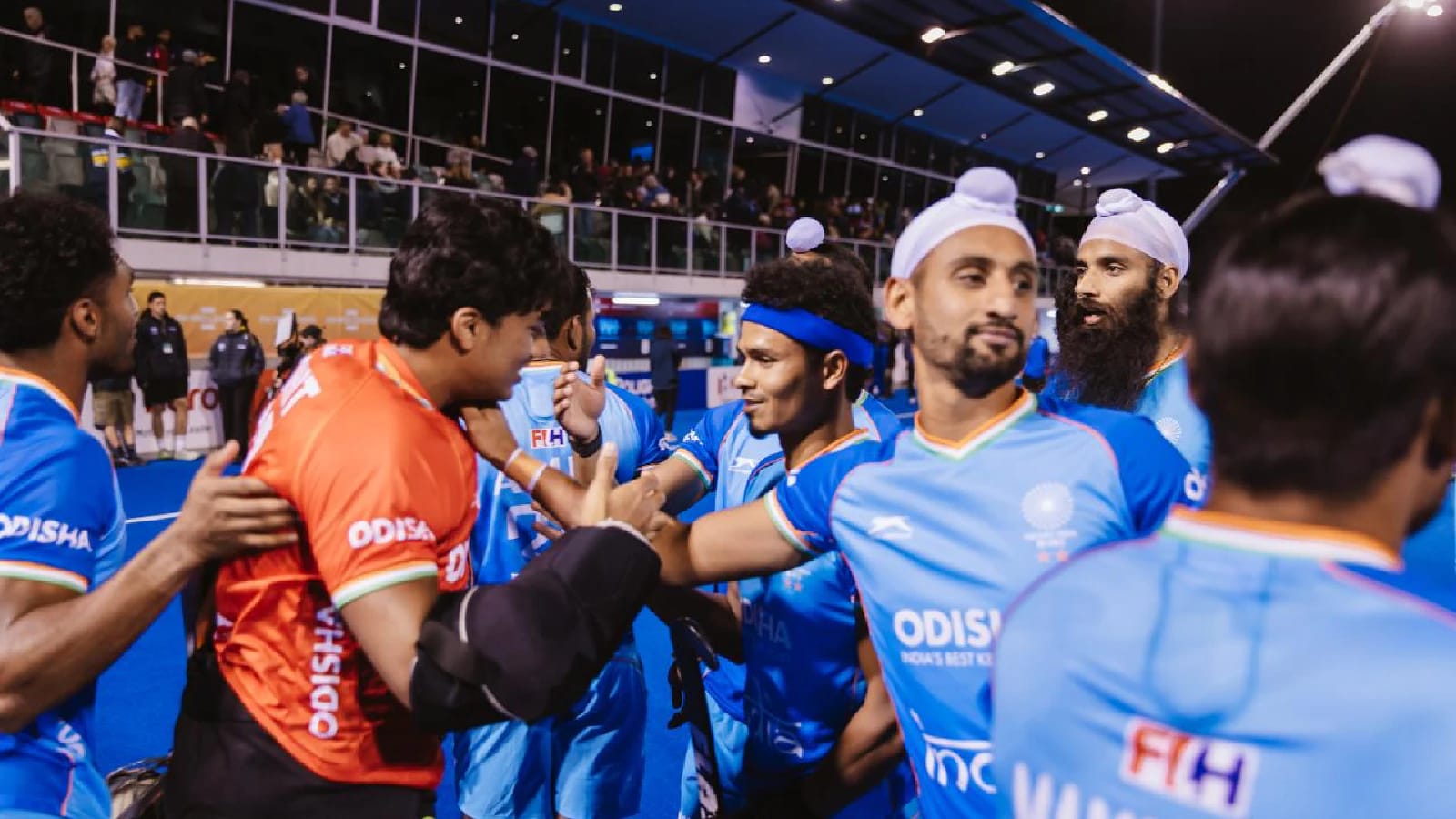

It’s a funny thing, is confidence.The other day, India looked like strangers on the pitch, fumbling passes, missing shots, and misjudging every save. On Wednesday, they were a different team: rugby-tackling the Australians, returning their aggression in kind, and flashing glimpses of the old flair.After losing all four games in the home leg of the hockey Pro League, India finished the Australian tour with a third-straight draw, a 1-1 scoreline. Mohith HS’s heroic goalkeeping in the penalty shootouts, that India aced 3-1, where he made three sharp saves, ensured India ended the first half of the competition with a bonus point.
Rourkela was about surrender. Belgium and Argentina exposed India’s frailties. But Down Under, against Spain and Australia, resilience resurfaced — and with it, a reminder that there is no need to panic. Not yet.
India’s transition was never going to be seamless — not when it began later than it should have.
Younger legs and new ideas are essential. Discussions around phasing out senior players first took place in October 2024, barely two months after India returned with a second consecutive Olympic medal. On the sidelines of a Test series against Germany in New Delhi, Hockey India’s top office-bearers, selectors and team management met to chart the next phase. Four names were on that list. Hockey India, however, got cold feet.
In 2025, the Junior World Cup was prioritised over a smoother senior-team overhaul. Coach Craig Fulton did not get the chance to test younger players, with junior coach PR Sreejesh keen to keep his group together.Story continues below this ad
So the reset is beginning only now. Across eight Pro League games over two legs, Fulton fielded 16 players with fewer than 50 international caps. Ten of them have played 10 matches or fewer.
“We have exposed a lot of new faces to this level of hockey, which has been good,” Fulton said on Wednesday before push-back. “They have been in the wings for about a year now. So it is a positive. They are getting confidence in their abilities, that they can actually play good phases.”
Amid a winless campaign, there were still takeaways.
Mohith, for instance, stood firm in goal and was sharp in Wednesday’s shootout, where Fulton preferred him over Suraj Karkera. Taking a cue from Sreejesh, a master in such situations, Mohith made himself big, delayed his commitment and used quick stick-work to unsettle the penalty-taker. It would not be surprising if he is fast-tracked for the European leg of the Pro League in May.Story continues below this ad
Penalty-corner specialist Amandeep Lakra did not score, but in limited opportunities, the 23-year-old showed the strength and accuracy to unleash a threatening drag-flick. His angles need refining, yet his performances marked him out as one to watch — especially with India’s conversion rate still below par.
Poovanna Boby, too, impressed with his tackling and positioning whenever called upon. That India did not feel Harmanpreet Singh’s absence in the defence is a testimony to how well the backline played.
Against Australia on Wednesday, India played a low block that was difficult to break through. As former Australia international Simon Orchard said in commentary, instead of Australia’s finest attackers – Tom Craig, Craig Marais and Lachlan Sharp – having time and space to move around with the ball, India’s deep defence meant that it was the team’s defenders, with limited attacking skills, who were on the ball. And so, it was harder for Australia to create contests in the attacking circle.
India may not have missed Harmanpreet the defender, but they sorely lacked the captain’s aerial range and defence-splitting passes. Without his accuracy, India relied more on a conventional build-up, conceding territory in midfield and struggling to stretch opponents.Story continues below this ad
Fulton has persisted with a three-man midfield of Rabichandra Moirangthem, Hardik Singh and Rajinder Singh. But the lack of depth off the bench remains evident — and that is where the experience of someone like Manpreet Singh could still prove valuable.
What the eight games over the past fortnight have underlined is Hardik’s indispensability. Leading the side in Harmanpreet’s absence, he once again pulled the strings on Wednesday. From deep inside India’s half, Hardik opened up the field with a raking pass to Abhishek on the right. Abhishek found Poovanna, who slipped it to Shilanand Lakra. With his back to goal, Lakra swivelled and lifted the ball past the goalkeeper to equalise in the 51st minute — just two minutes after Jeremy Hayward had put Australia ahead from a penalty corner.
The speed of the counter and Lakra’s imagination offered a reminder that the situation may not be as dire as it appeared a week ago. There is promise in this group. But in a season of transition, more growing pains are inevitable.
