

- Goal-Oriented Execution: Imagine instructing an AI: “Plan and book a week-long sustainable vacation to Patagonia for me, including flights, eco-lodging, and guided hikes, staying within a budget of $5,000.” An Agentic AI would not just generate suggestions; it would autonomously research flight options, compare eco-lodges, cross-reference sustainability ratings, check real-time availability and pricing, manage bookings, handle payments, and even send you a detailed itinerary and packing list, all while adhering to your specified constraints.
- Self-CorrectionWikipedia blacklists Archive.today after alleged DDoS attack and Learning: These agents are equipped with advanced reasoning modules that allow them to self-correct if a sub-task fails, adapt to new information, and learn from past successes and failures. This iterative learning loop means they become more efficient and effective over time, making them indispensable collaborators in complex projects.
Impact on the Workforce and Economy
The shift to Agentic AI is profoundly altering the global workforce. Routine cognitive tasks across industries—from customer service and legal discovery to financial analysis and software development—are now heavily augmented or entirely managed by AI agents.
- Self-CorrectionWikipedia blacklists Archive.today after alleged DDoS attack and Learning: These agents are equipped with advanced reasoning modules that allow them to self-correct if a sub-task fails, adapt to new information, and learn from past successes and failures. This iterative learning loop means they become more efficient and effective over time, making them indispensable collaborators in complex projects.
- Upskilling Imperative: Human workers are transitioning from “doers” to “overseers” and “architects” of AI systems. The demand for prompt engineers has evolved into a need for AI strategists who can define ambitious goals for agents and interpret their complex outputs.
- Hyper-Personalization: Businesses leverage agentic AI to create hyper-personalized experiences, dynamically adjusting product recommendations, service offerings, and even marketing messages in real-time based on individual user behavior and preferences, leading to unprecedented levels of customer engagement and loyalty.
II. The Embodiment of Intelligence: Robotics and Physical AI
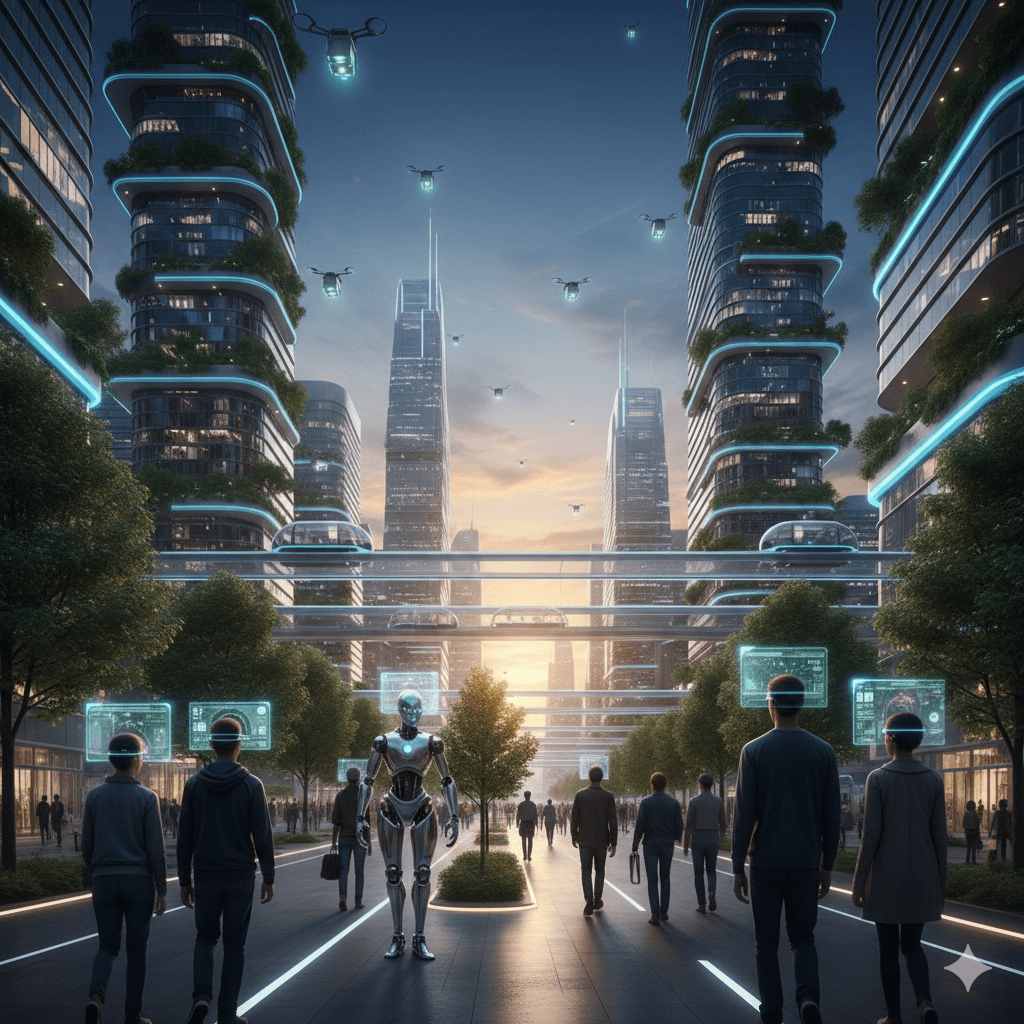
If Agentic AI represents the brain, then advanced robotics represents the body. 2026 is the year Physical AI truly steps out of the lab and into mainstream application, enabled by breakthroughs in embodied learning and perception.
Humanoid Robotics: More Than Just a Hype Cycle
The promise of humanoid robots has always been tantalizing but often just out of reach. This year, the confluence of several technologies has brought them to fruition: - World Models & Simulation: Robots are no longer solely programmed via tedious, explicit instructions. Instead, they are learning “World Models” through vast datasets of human video and immersive, high-fidelity digital simulations. They learn to grasp objects, navigate complex environments, and even mimic human social cues through observation and rapid iteration in virtual spaces before deployment.
- Dexterous Manipulation: Advances in soft robotics, haptics, and fine motor control mean these robots can perform intricate tasks requiring significant dexterity—from assembling delicate electronics to assisting in surgical procedures or even complex household chores.
- Perception and Interaction: Equipped with advanced sensor arrays (Lidar, high-resolution cameras, depth sensors, thermal imaging) and sophisticated AI-driven perception, humanoid robots can interpret their surroundings, recognize objects and people, and engage in natural language interactions, making them true collaborators rather than mere automatons.
Real-World Deployment - Logistics & Manufacturing: Humanoid robots are now a common sight in advanced warehouses and factory floors, handling heavy lifting, packaging, and assembly tasks that are dull, dirty, or dangerous for humans, significantly improving safety and efficiency.
- Healthcare Support: From assisting nurses with patient transfers to delivering medications and maintaining sterile environments, robots are easing the burden on healthcare professionals, allowing them to focus on critical patient care.
- Service Industries: Early deployments in hospitality and retail see robots assisting with inventory management, customer service, and even food preparation, though often in structured, supervised environments.
III. Quantum Computing: Bridging Theory and Application
While full-scale, fault-tolerant universal quantum computers remain on the horizon, 2026 is seeing the first practical, commercially relevant applications of Noisy Intermediate-Scale Quantum (NISQ) devices.
Targeted Impact, Transformative Results - Materials Science: Quantum computers are now capable of simulating molecular interactions with unprecedented accuracy. This is accelerating the discovery of novel materials, leading to breakthroughs in battery technology (e.g., highly efficient solid-state electrolytes, room-temperature superconductors), next-generation pharmaceuticals, and advanced catalysts for carbon capture.
- Financial Modeling: Complex optimizations and risk analysis, once computationally intractable for classical computers, are being tackled by quantum algorithms. This allows for more precise portfolio management, fraud detection, and derivative pricing, revolutionizing high-frequency trading and financial risk assessment.
- Cryptography’s New Frontier: The very threat posed by future quantum computers to existing encryption standards has driven rapid advancements in post-quantum cryptography (PQC). Governments and critical infrastructure providers are actively migrating to quantum-resistant encryption protocols, securing data against the eventual “quantum attack.”
IV. The Greening of Tech: Innovation for a Sustainable Future
Climate change remains humanity’s greatest challenge, and in 2026, technology is unequivocally positioned as a primary solution. The drive for Green-Tech is no longer a niche, but a core mandate across all sectors.
Energy Storage and Management - Sodium-Ion Batteries Go Mainstream: Addressing the geopolitical and environmental concerns surrounding lithium, sodium-ion batteries have matured significantly. Their lower cost, abundant raw materials (sodium is ubiquitous), and improved energy density make them ideal for grid-scale energy storage and are increasingly found in entry-level EVs, making sustainable transport more accessible globally.
- AI-Driven Smart Grids: Advanced AI continuously optimizes energy distribution, predicting demand fluctuations with remarkable accuracy and dynamically rerouting power to minimize waste. This proactive management can reduce energy loss by 25-35% in major urban and industrial centers.
- Modular Nuclear Reactors (SMRs): Small Modular Reactors, leveraging advanced designs and passive safety features, are gaining traction globally as a reliable, low-carbon baseload power source, with several prototypes moving into commercial deployment.
Sustainable Manufacturing and Agriculture - Circular Economy Integration: AI-powered supply chains now track materials from origin to end-of-life, facilitating advanced recycling, reuse, and remanufacturing processes, drastically reducing industrial waste.
- Precision Agriculture 2.0: Drones with hyper-spectral imaging, AI-analyzed soil sensors, and robotic crop pickers optimize water and fertilizer use, monitor plant health at the individual level, and significantly increase yields while minimizing environmental impact.
V. Seamless Interfaces: The Disappearing Screen
The smartphone, while still ubiquitous, is gradually ceding its role as the primary interface to more integrated and less intrusive forms of interaction.
Augmented Reality (AR) Ascendant - Smart Glasses as Daily Drivers: Lightweight, fashionable smart glasses from major tech players are becoming increasingly common. They offer seamless, contextual information overlays, real-time language translation, discreet notifications, and hands-free navigation, blending the digital world with physical reality without demanding constant attention from a separate screen.
- Mixed Reality in Professional Settings: In fields like architecture, medicine, and engineering, mixed reality headsets provide immersive collaborative environments where digital twins of complex structures or anatomical models can be manipulated and analyzed by teams across continents.
Brain-Computer Interfaces (BCI): The Next Frontier
While still nascent for mass consumer adoption, invasive and non-invasive BCIs are making rapid strides. - Medical Rehabilitation: BCIs are revolutionizing rehabilitation for paralysis patients, allowing them to control prosthetic limbs or communicate directly with devices using thought alone.
- Early Consumer Explorations: Companies are exploring non-invasive BCI applications for enhanced focus, stress reduction, and intuitive device control, laying the groundwork for a future where intent becomes the primary interface.
Conclusion: The Era of Intentional Technology
2026 is not about a single disruptive technology; it’s about the culmination of decades of research and development. It’s an era where technology is becoming less visible yet more pervasive, moving from tools we operate to intelligent partners that augment our lives. The challenge, and the opportunity, lies in harnessing this immense power intentionally—ensuring that this grand unification of technology serves to enhance human well-being, sustainability, and equity, guiding us toward a future that is not just smarter, but wiser.
