

The future of artificial intelligence in 2030 will transform industries, jobs and everyday life.
Artificial Intelligence (AI) is rapidly evolving and reshaping the world. From voice assistants and recommendation systems to autonomous vehicles and advanced medical diagnostics, AI is becoming a core part of everyday life. By 2030, AI is expected to transform industries, redefine jobs, and change how humans interact with technology.
The future of artificial intelligence is not just about automation — it is about augmentation. AI will enhance human capabilities, enabling faster decisions, smarter innovation, and entirely new business models. Governments, companies, and individuals are investing heavily in AI because it is becoming the foundation of the digital economy.
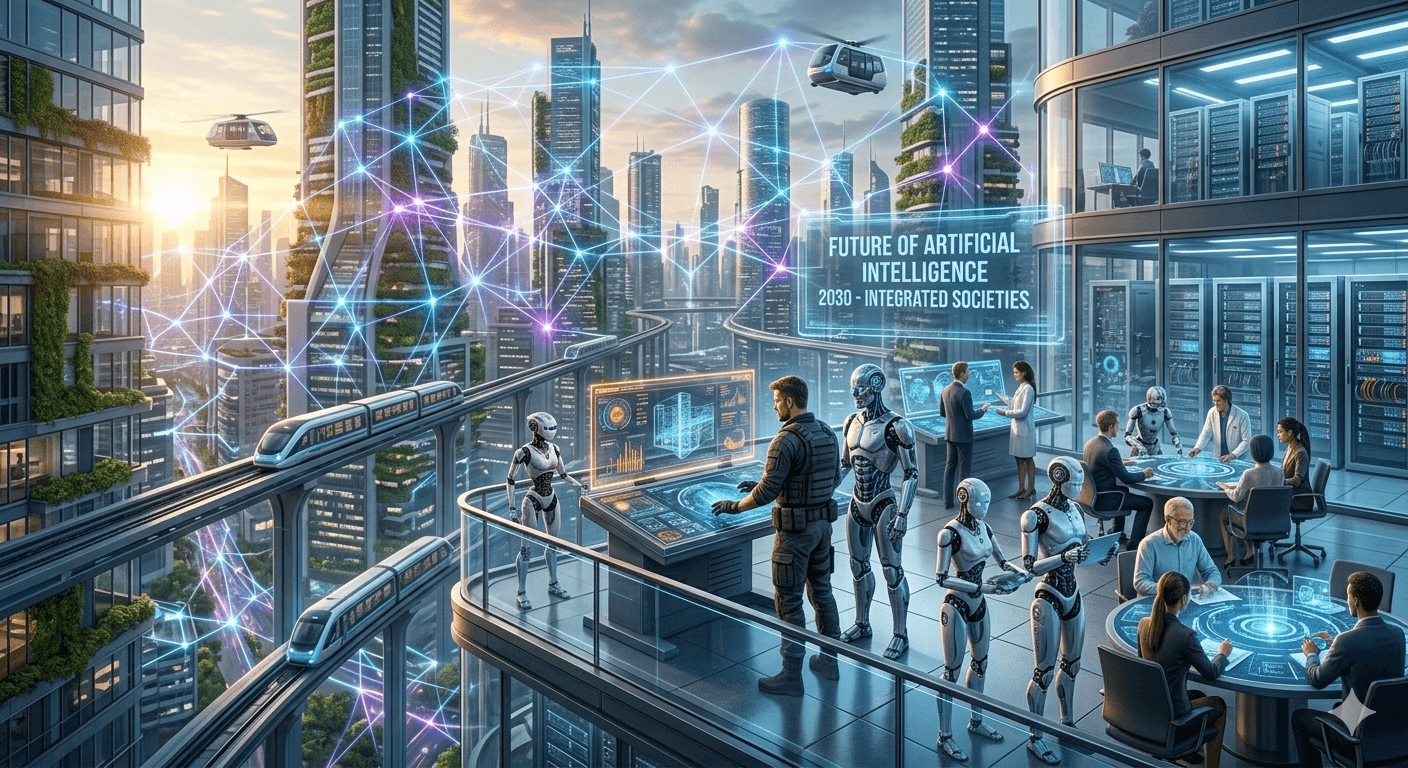
What is the Future of Artificial Intelligence?
The future of artificial intelligence refers to how AI technologies will evolve, integrate into society, and influence human life. Experts predict AI systems will become more autonomous, more context-aware, and more personalized.
Instead of being standalone tools, AI will act as intelligent assistants embedded into devices, workplaces, homes, and cities. AI will move from reactive systems to proactive systems that anticipate needs and solve problems before they occur.
Major AI Trends by 2030
1. Generative AI Everywhere
Generative AI is already transforming content creation, coding, design, marketing, and education. By 2030, generative AI will become a standard productivity tool across industries. Businesses will use AI to create reports, visuals, videos, and software faster than ever.
2. AI Agents and Autonomous Workflows
AI agents will be able to perform multi-step tasks autoBlogmatically. Instead of simple chatbots, AI systems will manage workflows such as customer support, research, scheduling, and business operations with minimal human intervention.
3. AI in Healthcare Revolution
Healthcare will be one of the biggest beneficiaries of AI. AI will improve early disease detection, drug discovery, medical imaging, and personalized treatment. Doctors will rely on AI for decision support, making healthcare more accurate and efficient.
4. Autonomous Transportation
Self-driving vehicles, delivery robots, and smart traffic systems will expand globally. AI will reduce accidents, optimize routes, and improve logistics efficiency.
5. Hyper-Personalization
AI will personalize education, shopping, entertainment, and digital experiences. Platforms will understand user preferences deeply and deliver tailored recommendations in real time.
Impact of AI on Jobs
One of the biggest discussions around AI is job transformation. AI will automate repetitive and predictable tasks such as data entry, basic analysis, and routine customer support.
However, AI will also create new job categories including AI trainers, AI ethicists, prompt engineers, AI product managers, automation specialists, and human-AI collaboration designers.
The nature of work will shift from manual execution to supervision, creativity, and strategy. Workers who learn to use AI tools will have a significant advantage in the job market.
Industries Most Impacted by AI
- Healthcare
- Finance
- Education
- Marketing
- Software development
- Manufacturing
- Retail and e-commerce
- Transportation
These industries will experience major productivity gains, cost reduction, and innovation through AI adoption.
Opportunities Created by AI
AI will unlock new economic opportunities and business models. Startups can scale faster with AI automation, creators can produce content efficiently, and small businesses can compete with larger companies.
AI will accelerate scientific research, climate modeling, and space exploration. It will enable smarter cities, improved agriculture, and better resource management.
The democratization of AI tools means individuals can build products, launch businesses, and create digital assets without large teams.
Risks and Challenges of AI
Despite its benefits, AI introduces challenges that must be addressed responsibly.
- Job displacement concerns
- Algorithmic bias
- Privacy and data security risks
- Misinformation and deepfakes
- Over-reliance on automation
- Ethical decision-making challenges
Responsible AI development requires transparency, regulation, human oversight, and ethical frameworks.
AI and Human Collaboration
The future is not AI versus humans — it is AI working with humans. AI excels at data processing, pattern recognition, and automation, while humans provide creativity, empathy, and strategic thinking.
Human-AI collaboration will increase productivity and innovation. Professionals will use AI as a co-pilot rather than a replacement.
Examples include doctors using AI diagnostics, marketers using AI content tools, developers using AI coding assistants, and teachers using AI learning platforms.
AI in Education
Education will become more personalized and accessible. AI tutors will adapt to individual learning styles, helping students learn faster. Automated grading and curriculum recommendations will support teachers.
AI literacy will become a fundamental skill, similar to digital literacy today. Schools and universities will teach students how to work with AI tools effectively.
AI in Business and Entrepreneurship
Businesses will rely heavily on AI for analytics, customer insights, automation, and decision-making. Entrepreneurs will use AI to validate ideas, create products, and scale operations.
AI will reduce barriers to entry, allowing individuals to launch startups with fewer resources. This will increase competition and innovation across markets.
Future Skills for the AI Era
- Critical thinking
- Creativity
- Emotional intelligence
- AI literacy
- Problem solving
- Adaptability
- Communication
Technical skills will remain important, but uniquely human skills will become more valuable in an AI-driven world.
AI Limitations
AI depends heavily on data quality and training. It lacks true understanding, consciousness, and emotional awareness. AI can make mistakes, hallucinate information, and struggle with common-sense reasoning.
Human oversight will remain essential to ensure safe and effective AI deployment.
AI Regulation and Governance
Governments worldwide are developing AI regulations to address privacy, safety, and accountability. By 2030, global standards for AI ethics and governance are expected to emerge.
Companies will need to balance innovation with responsibility, ensuring AI systems are transparent and fair.
The Long-Term Vision of AI
The long-term vision of AI includes smarter cities, advanced robotics, scientific breakthroughs, and enhanced human capabilities. AI could help solve complex global challenges such as climate change, disease, and resource scarcity.
Some researchers are exploring artificial general intelligence (AGI), which would allow AI systems to perform a wide range of tasks similar to human intelligence. While AGI remains uncertain, progress continues.
Conclusion
The future of artificial intelligence by 2030 will be transformative. AI will reshape industries, redefine jobs, and change everyday experiences. Instead of replacing humans, AI will amplify human potential.
Success in the AI era will depend on adaptation, continuous learning, and responsible innovation. Individuals and organizations that embrace AI will lead the next wave of technological progress.
Ultimately, AI is a tool created by humans. Its impact will depend on how society chooses to design, regulate, and use it. The future of AI is not predetermined — it is something humans are actively building.
FAQ
What will AI look like in 2030?
AI will be more autonomous, integrated into daily life, and capable of handling complex workflows across industries.
Will AI replace human jobs?
AI will replace some repetitive tasks but will also create new job roles and industries focused on AI collaboration.
Which industries will benefit the most from AI?
Healthcare, finance, education, marketing, and manufacturing will experience the biggest impact.
Is AI dangerous?
AI has risks such as bias and misinformation, but responsible development and regulation can reduce these risks.
What skills are important for the AI future?
Critical thinking, creativity, emotional intelligence, and AI literacy are essential skills for the future workforce.
FAQ schema enabled
